
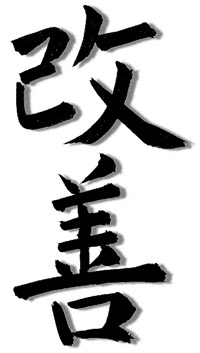
Kaizen is the practice of continuous improvement that has kept companies like Toyota and Ford one step ahead of the competition for years. In this post I would like to discuss application of the Kaizen philosophy and practice to one’s Reiki Practice in an attempt to quantify it and simultaneously make it the very best that it can be.
What is Kaizen?
The Kaizen Revolution is the result of the introduction of statistics based quality control systems to Japan in the 1950s by William Edwards Deming. Since that time, the Kaizen philosophy has undergone some Kaizen of its own as Japanese businesses have continued to incrementally improve on the Kaizen philosophy and make it their own.
In a nutshell, using the Kaizen philosophy you apply similar experiential thinking to business as you would to learning anything else in life. For example, if you were to read a book about swimming, would you qualify for a gold medal in the Olympics? Not necessarily. Using the Kaizen approach though you would work on various aspects of your swimming (muscle development, different strokes, breathing techniques, etc.) one at a time, and “incrementally improve” on each of them. This cycle continues indefinitely, and while you probably won’t qualify for a gold medal in the Olympics anytime soon, you will be consistently improving and well on your way. That’s the Kaizen approach.
Kaizen in Reiki
At the heart of Kaizen lies continuous testing, in order to ascertain if the continuous improvements are having the desired effect or not. You change or try something, if its an improvement you keep it, if not you go back and try something else. Yesterday, in my post on Reiki Testing, I introduced some quick ways to incorporate testing into your daily Reiki practice. Reiki Kaizen is one way of systematizing that approach.
As previously mentioned, I consider testing to be one of the central pillars in developing one’s Reiki Mastery and all too often it is largely overlooked. I’m not sure why that is, either Reiki practitioners are not taught the importance of testing in their Reiki practice, or they are not motivated enough to do so. Admittedly it does take some time, but if done in the Kaizen spirit, it can be easily added to any Reiki practice to transform it into a a Reiki Superpractice and soon enough you’ll be leaping tall buildings in a single bound.
Okay, maybe not so soon, but you get the picture.
Taguchi Method in Reiki
The Kaizen method I’d like to present to you is a little known system used in quality control called the Taguchi Method. This a Kaizen application developed by Genichi Taguchi in the 1950s just as the Kaizen idealogy was taking root in Japan. It was soon adopted by Toyota in their quality control department and it is the opinion of many business analysts that this system is largely responsible for Toyota’s success today. In a nutshell, the Taguchi Method multiplies the effects of Kaizen and brings it to a whole new level by using systematized multi-variate testing (testing more than one thing at a time).
There is software available for doing Taguchi applications, but the system I use is an extremely simple approach adapted for Reiki practice. The only tool you need is a spreadsheet and some method of quantification.
What The Bleep Is Quantification?
Okay, big word, easy idea. Quantification refers to measuring something using numbers. In this approach I recommend using a scale of 1 to 10. For example, on a scale of 1 to 10 how would you rate your ability to know when the Reiki energies are flowing? How would you rate your hibiki sensing ability? How would you rate your ability to distinguish between the energy of the different Reiki symbols? How would you rate your understanding of the basic fundamentals of Reiki? Etc.
Since these numbers are for your own personal use, there is no way (or need) to compare them with anyone else. They are based upon your own perceptions and you can judge yourself any way you like. You are the testor and the testee (and you alone decide if you pass or fail). 

Here are the easy steps to follow:
- Make a list of everything in Reiki that is important to you and quantifiable (don’t worry you can always add stuff later if you miss anything).
- Rate each item in the list on a scale of 1 to 10 (if you don’t know… guess… you can always go back and change it later).
- Sort this list into categories (for example, healing, energy work, spiritual practice, business, history, education, psychology, etc.)
- Choose one item from each category to focus on for the next month.
- After one month rate each item in the list again (even the ones you weren’t focusing on).
- Choose new items to focus on for the next month (changing them keeps things interesting).
- Rinse and repeat.
The first few months may seem chaotic and it may appear like not much is happening. However, if you continue, you will begin to notice patterns and trends and your mind will eventually take the philosophy to heart as you start to get it. After which you will have a much greater degree of control over the whole system, you spreadsheet will start to grow as you go into greater detail, you can make pretty charts to hang on the refrigerator and you will begin to feel your practice evolving. Not only that but you will have the numbers to prove that it really is!
Whether you embrace Kaizen or not, use Taguchi or not, try this easy approach or not, is, of course, up to you. I do, however, encourage you to start testing in whatever way is comfortable for you as that really is the only way to gauge your Reiki performance. If all of this just doesn’t matter to you, that’s fine… and I’m sure those that don’t think it important will not have read this far anyway… 
For further explanation or discussion, your thoughts are most welcome and highly encouraged, please feel free to comment below!!!